Mathematical Foundations of Computer Networking (häftad, eng)
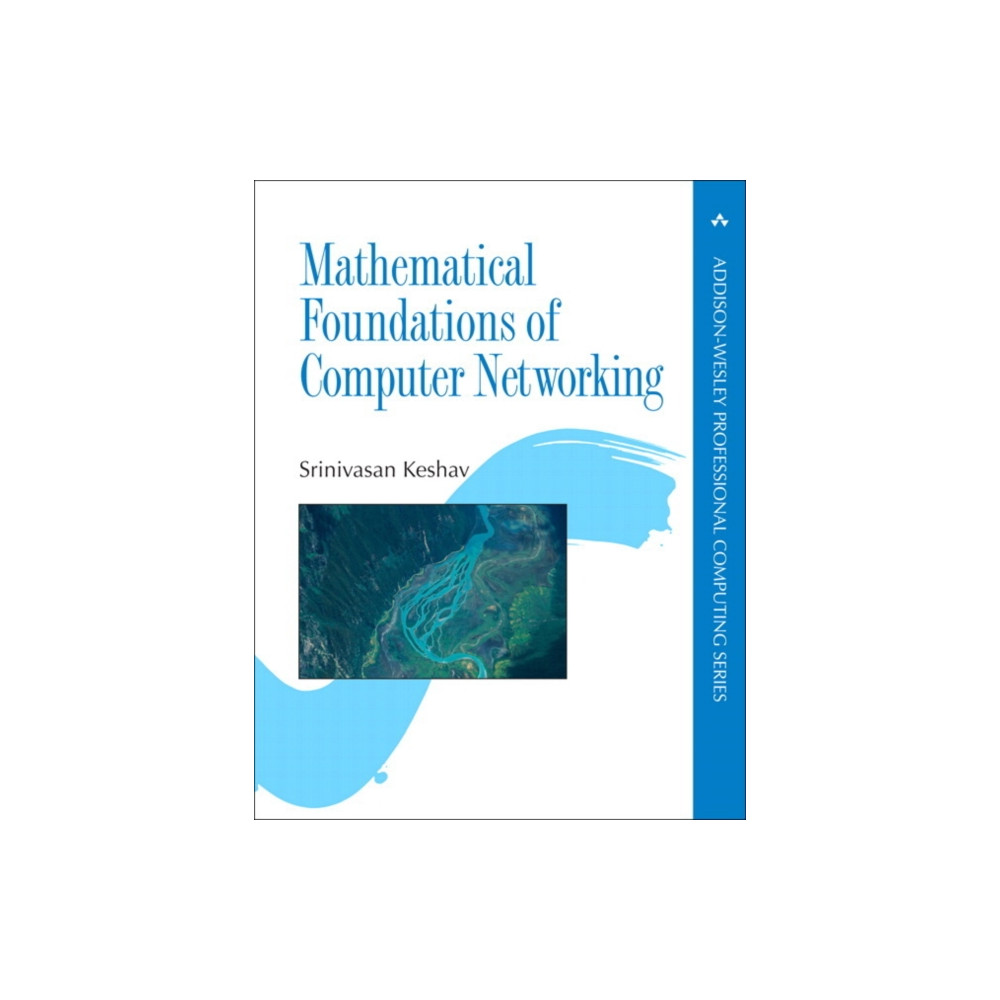
Mathematical Foundations of Computer Networking (häftad, eng)
Gästpris:
Ditt medlemspris:
666 kr
770 kr
Kampanjpris! (-6%)
Kampanjpris! (-19%)
- Inköpspriser för medlemmar (Logga in)
- Frakt från 0 kr
- 14 dagars öppet köp
Frågor? Starta chatt

“To design future networks that are worthy of society’s trust, we must put the ‘discipline’ of computer networking on a much stronger foundation. This book rises above the considerable minutiae of today’s networking technologies to emphasize the long-standing mathematical underpinnings of the field.”
–Professor Jennifer Rexford, Department of Computer Science, Princeton University
“This book is exactly the one I have been waiting for the last couple of years.
Recently, I decided most students were already very familiar with the way the net works but were not being taught the fundamentals–the math. This book contains the knowledge for people who will create and understand future communications systems."
–Professor Jon Crowcroft, The Computer Laboratory, University of Cambridge
The Essential Mathematical Principles Required to Design, Implement, or Evaluate Advanced Computer Networks
Students, researchers, and professionals in computer networking require a firm conceptual understanding of its foundations.
Mathematical Foundations of Computer Networking provides an intuitive yet rigorous introduction to these essential mathematical principles and techniques.
Assuming a basic grasp of calculus, this book offers sufficient detail to serve as the only reference many readers will need.
Each concept is described in four ways: intuitively; using appropriate mathematical notation; with a numerical example carefully chosen for its relevance to networking; and with a numerical exercise for the reader.
The first part of the text presents basic concepts, and the second part introduces four theories in a progression that has been designed to gradually deepen readers’ understanding.
Within each part, chapters are as self-contained as possible.
The first part covers probability; statistics; linear algebra; optimization; and signals, systems, and transforms. Topics range from Bayesian networks to hypothesis testing, and eigenvalue computation to Fourier transforms.
These preliminary chapters establish a basis for the four theories covered in the second part of the book: queueing theory, game theory, control theory, and information theory.
The second part also demonstrates how mathematical concepts can be applied to issues such as contention for limited resources, and the optimization of network responsiveness, stability, and throughput.
| Format | Häftad |
| Omfång | 496 sidor |
| Språk | Engelska |
| Förlag | Pearson Education (US) |
| Utgivningsdatum | 2012-05-10 |
| ISBN | 9780321792105 |
Artikelnummer
3454854
EAN
9780321792105
Leverans:
Denna produkt skickas från oss inom 6 - 7 vardagar. I kassan väljer du om du vill få leverans med Budbee, Airmee, Best Transport, Early Bird, Postnord eller DB Schenker. Vissa speditörer har vikt- eller storleksbegränsningar och kan av den anledningen saknas som alternativ i kassan om du handlar många eller väldigt stora produkter.Fri retur:
För medlemmar gäller fri retur och 14 dagars full returrätt från den dagen du tar emot din leverans. För övriga kostar retur från 49 kr.Undantag för retur- och ångerrätt:
Dessa är exempel på varor som inte omfattas av retur- eller ångerrätt. Observera att det kan finnas andra undantag som inte listas här.- Använda, skadade och/eller inkompletta produkter
- Dagligvaror (livsmedel, läkemedel, nikotinprodukter)
- Hygienartiklar & kroppsnära produkter (rakapparater, in ear-hörlurar, aktivitetsklockor)
- Intimprodukter (menskoppar, kondomer och glidmedel)
- Kosmetikprodukter (inkl. hår- och hudvårdsprodukter, parfymer, etc.)
- Underkläder (inkl. badkläder, underställ och strumpor)
- Ljud- & bildupptagningar, spel/program (om förseglingen brutits eller licensnyckeln erhållits.)
- Teknikprodukter om försegling brutits eller programvara har installerats (mobiltelefoner, surfplattor, laptops, etc.)
- Gratisprodukter
Om du är osäker på om en produkt omfattas av ångerrätt kan du alltid kontakta vår kundtjänst på info@buyersclub.se, så hjälper vi dig gärna!
Leveranser: